Monday, November 8, 2010

red lights


I think everybody must have experienced a "red light", somewhere along the line. Or is it just me? A "red light" is when you are gliding - or maybe, to put it more aptly, sliding - along, going about your day-to-day life, thinking that everything is okay... when something hits you over the head and makes you realise that it's not. You are not the person you want to be, and your life is not the life you want it to be. You have gone awry. You are lost. So you stop still, at the red light, and wonder what on earth to do next.

For me, life can sometimes take on the form of an imperceptible avalanche, gradually gathering speed. You see, I have these wild and wonderful ideas about what I want for myself. I know exactly what I want to achieve in my life, how I want my days to unfold, what I want to learn, the kind of food I want to eat, the books I want to read. The problem is that, as firm as my convictions may be, a lot of those fantasies fall by the wayside. So why keep at it? Why do I envision these goals and dream of my "ideal" lifestyle, if it rarely comes to anything?

To tell the truth, I don't know how to answer that question. Nevertheless, I do think that goals are essential. The business, stress and temptations we are faced with every single day make it so easy for us to lose sight of where we want to go. A streamlined vision gives us parameters. It helps to convince us to prune our lives, figure out where we are going wrong, and keep improving. Because it's when those parameters are stretched too wide that we veer off course, and we become more and more lenient with ourselves... until we get to a point where we sit back and think, "Where am I? This is so far from where I want to be that it's not funny!"

Maybe it is a dead-end job, a stale relationship, hurtful friendships, hours wasted online and watching TV, staying home instead of going out, buying food instead of cooking it, sitting on the couch instead of going for a walk, sleeping in instead of waking up early... At the time, we think these things make us happy. Or, at least, comfortable. But they don't, really. It makes us feel disappointed with ourselves, in the broad scheme of things. We are truly happy with ourselves when we uphold a semblance of discipline, particularly when we reap the rewards later. It's not that we should not take a break every now and then, indulge when we need  a pick-me-up, be kind to ourselves when we fail to live up to own own expectations... that is all really, really important. But we need to take charge of our own lives, and create a life that we can be proud of. Achieve amazing things. Go beyond what we think we can do. We need to be able to look back, pat ourselves on the back and say, "Wow! You did a good job".

So I guess the moral of this post is... dream. Set goals. Reassure yourself. Know what you want. Wish. I don't have much advice for how to get to those dreams. But I think the dream itself is important. You may have already guessed that I have recently hit one of those red lights I mentioned earlier. Which is a good thing, because I am determined to make some changes. (And when I say make some changes, I mean actually make them, not just plan to make them...) Stay tuned!

"If you want to make your dreams come true, the first thing you have to do is wake up."
— J.M Powers

Friday, November 5, 2010

some thoughts on writing


At present, I'm writing a little review of Eat Pray Love, the movie, which should be up in a week or so. In the meantime, I was perusing Elizabeth Gilbert's website for some research material and came across "Some Thoughts on Writing" - Liz's sage advice for aspiring writers, which I think would also apply (at least partially) to bloggers, artists, and perhaps anybody striving to achieve what seems like a far-off dream...

... I believe that – if you are serious about a life of writing, or indeed about any creative form of expression – that you should take on this work like a holy calling. I became a writer the way other people become monks or nuns. I made a vow to writing, very young. I became Bride-of-Writing. I was writing’s most devotional handmaiden. I built my entire life around writing. I didn’t know how else to do this. I didn’t know anyone who had ever become a writer. I had no, as they say, connections. I had no clues. I just began.

... I created my own post-graduate writing program, which entailed several years spent traveling around the country and world, taking jobs at bars and restaurants and ranches, listening to how people spoke, collecting experiences and writing constantly. My life probably looked disordered to observers (not that anyone was observing it that closely) but my travels were a very deliberate effort to learn as much as I could about life, expressly so that I could write about it.

... Send your work off to editors and agents as much as possible, show it to your neighbors, plaster it on the walls of the bus stops – just don’t sit on your work and suffocate it. At least try. And when the powers-that-be send you back your manuscript (and they will), take a deep breath and try again. I often hear people say, “I’m not good enough yet to be published.” That’s quite possible. Probable, even. All I’m saying is: Let someone else decide that. Magazines, editors, agents – they all employ young people making $22,000 a year whose job it is to read through piles of manuscripts and send you back letters telling you that you aren’t good enough yet: LET THEM DO IT. Don’t pre-reject yourself. That’s their job, not yours. Your job is only to write your heart out, and let destiny take care of the rest.

... As for discipline – it’s important, but sort of over-rated. The more important virtue for a writer, I believe, is self-forgiveness... Continuing to write after that heartache of disappointment doesn’t take only discipline, but also self-forgiveness (which comes from a place of kind and encouraging and motherly love). 

...  Always, at the end of the day, the important thing is only and always that: Get back to work. This is a path for the courageous and the faithful. You must find another reason to work, other than the desire for success or recognition. It must come from another place.

... Writing is not like dancing or modeling; it’s not something where – if you missed it by age 19 – you’re finished. It’s never too late. Your writing will only get better as you get older and wiser. If you write something beautiful and important, and the right person somehow discovers it, they will clear room for you on the bookshelves of the world – at any age. At least try.

... Everyone I know who managed to become a writer did it differently – sometimes radically differently. Try all the ways, I guess. Becoming a published writer is sort of like trying to find a cheap apartment in New York City: it’s impossible. And yet…every single day, somebody manages to find a cheap apartment in New York City. I can’t tell you how to do it. I’m still not even entirely sure how I did it. I can only tell you – through my own example – that it can be done. I once found a cheap apartment in Manhattan. And I also became a writer.

... My suggestion is that you start with the love and then work very hard and try to let go of the results. Cast out your will, and then cut the line. 

... If you decide to write, then you must do it, as Balzac said, “like a miner buried under a fallen roof.” Become a knight, a force of diligence and faith. I don’t know how else to do it except that way. As the great poet Jack Gilbert said once to young writer, when she asked him for advice about her own poems: “Do you have the courage to bring forth this work? The treasures that are hidden inside you are hoping you will say YES." 

To sum it up, I would say that Liz's advice amounts to...
... Write
... Live and breathe writing
... Travel
... Share your writing
... Forgive yourself
... Get back to work
... At least try

And most importantly...
... Your job is only to write your heart out, and let destiny take care of the rest... start with the love and then work very hard and try to let go of the results. Cast out your will, and then cut the line.

I think I can handle that.

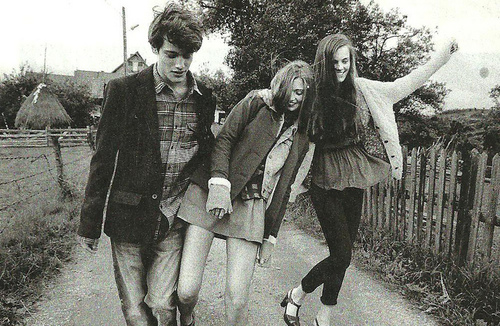
(Picture via partytights)

Tuesday, November 2, 2010

groundhog day


Last week I watched Groundhog Day, for what was probably the trillionth time. It is a really wonderful, classic film.

I guess there is a lot that you can take away from it. The themes are intertwining and ever-lasting: self-improvement, prioritising, generosity, the pursuit of happiness, and all that.

This time, what really spoke to me was, how much we can fit into a day. I mean, if we truly fill our days to the brim, there is so much that we can do and achieve. Every single day is a fresh opportunity to learn something new, initiate a friendship, foster a skill, make a difference in somebody else's life... fall in love. Do something truly great. 

That realisation (or lack thereof) is something I really struggle with. I tend to embroil myself in a downward spiral, day after day, allowing the previous day's mood, worries and ennui to colour what happens the next... rather than nurturing the awareness that everyday is a completely blank slate, yet another chance to start anew (to break through walls we have built around ourselves; to change whatever needs changing; to dream; to take the next step; to cherish the beauty all around us).

“Every morning we are born again. What we do today is what matters most.”
— Siddhārtha Gautama

Monday, November 1, 2010

let's go


Listen; there's a hell of a good 
universe next door: let's go.
e.e. cummings

Sunday, October 31, 2010

a letter


The other day, I read this lovely post by Gaynor Alder of The Modern Woman's Survival Guide in which she wrote a heartfelt letter to her 16-year-old self. It drew me into a cloud of nostalgia and I took up her invitation to write such a letter to myself at the same age. Here it is, reposted in all its glory...

Dear 16-year-old Me…

Be true to yourself.
Take chances.
Read.
Don’t diet.

Love, 21-year-old Me.

I think those four lines sum everything up perfectly... there's not much else to say. Life is simple really, when you think about it. Of course, that's easy to say when you're looking back, but not so easy to believe when you're in the midst of it.

P.S. Please spare a few minutes to take a hop, skip and a jump over to Gaynor's riveting travel tale Byron Bay: The Uncut Version... it's truly brilliant. 

Saturday, October 30, 2010

the searchers

"I am one of the searchers. There are, I believe, millions of us. We are not unhappy, but neither are we really content. We continue to explore life, hoping to uncover its ultimate secret. We continue to explore ourselves, hoping to understand. We like to walk along the beach, we are drawn by the ocean, taken by its power, its unceasing motion, its mystery and unspeakable beauty. We like forests and mountains, deserts and hidden rivers, and the lonely cities as well. Our sadness is as much a part of our lives as is our laughter. To share our sadness with one we love is perhaps as great a joy as we can know - unless it be to share our laughter.

We searchers are ambitious only for life itself, for everything beautiful it can provide. Most of all we love and want to be loved. We want to live in a relationship that will not impede our wandering, nor prevent our search, nor lock us in prison walls; that will take us for what little we have to give. We do not want to prove ourselves to another or compete for love.

For wanderers, dreamers, and lovers, for lonely men and women who dare to ask of life everything good and beautiful. It is for those who are too gentle to live among wolves."

— James Kavanaugh (There Are Men Too Gentle to Live Among Wolves)


Friday, October 29, 2010

the infinite abyss

I am a bit of a nerd. A soul nerd. But also a story nerd. One of the things I do for fun is track down and read the original scripts of my favourite movies, trying to find the true heart behind the story, which is often hidden within the polish of the finished product. They are pretty easy to find (all you need is a little Google sleuthing) and it is fascinating to get an idea of how the draft was moulded and amended to create a profitable film. Plus, it's great practice for writing the Oscar-winning screenplay based upon my Man Booker Prize-winning novel. (Just kidding.)


I watched Garden State when it was first released. I loved it right away, and it has since been one of my favourite movies. There is something refreshingly awkward about it. I like that it's not a perfectly flowing film. I like the often jarring, messy dialogue, peppered with moments of hilarity. I think that has something to do with the writer taking the role of the director and the lead actor. The fact that Zach Braff's protagonist, Large, is not the cookie-cutter Hollywood heartthrob but, rather, a confused, floppy haired "soul nerd" with a dopey expression plastered onto his face, is endearing. And, of course, nobody can help but fall head over heels in love with the adorable pathological liar, Sam, beautifully played by Natalie Portman. (That said, Rachel Hills writes a brilliant article on her character, as well as Kirsten Dunst's Claire in Elizabethtown, being "the alternative flat female fantasy".)


The funny thing is that I think I only just "got" Garden State. Only after watching it again, for the first time in about a year, and reading the original script, equipped with my present whimsy-ness and disillusionment, have I finally grasped the message that Zach was trying to portray. I mean, I have always appreciated the film, even when I watched it for the first time at the age of 15. But, oddly enough, I had never really understood it before now. Which I think is an accomplishment, on Zach's part, to create a film which somebody can enjoy without absorbing it at all. It shows how multi-layered and universal it is. 


One of the analogies I have only just fully identified with is The Infinite Abyss. For those of you who don't know or don't remember, Large (Zach), Sam (Natalie) and Mark (Peter Sarsgaard) go on a little adventure towards the end of the film, trying to track down a momento (I won't spoil it). Their ultimate destination is a natural phemonenon, a huge underground crevice in the earth which was discovered during the construction of a new mall. There, they meet a family who live in a makeshift house, a boat on stilts, whose job it is to protect the quarry from the company who still want to build upon it. I guess I just like the idea of doing something completely unique, says Albert, the guardian of the infinite abyss. Something that has never been done before. Afterwards, Large, Sam and Mark stand in the pouring rain, on a tractor, wearing garbage bags, screaming into the chasm. And then Large and Sam kiss, for the first time. I had always disassociated myself from that moment, thinking that was just weird. But now I get the full picture; which is that the infinite abyss is, of course, life. We think that we are trapped, but we really have all the freedom in the world. And once we know it, we can use it. Tellingly, the film was supposed to be called Large's Ark, but nobody really understood what it meant.


Before this post ends, I just want to address the critics of this film. A lot of people hate it, with a passion. They say it is stupid, pointless, self-indulgent and boring. I won't dispute those reactions; everybody is entitled to their opinion and I don't doubt that they really felt that way about the film. I just wanted to say that I think that idiosyncrasy is what makes a great film, or website, or article, or book, or message. When you are watching or reading or hearing a story, those "aha" moments don't come when you come across an entirely universal, clichéd phrase or moment that you have seen a million times before. Those "shock treatments" occur when you come across something that you were convinced was completely unique to you... but watching or reading the piece makes you realise that, wow, actually, somebody else has had exactly the same thought or experience... isn't that funny? Those touching reactions can only be achieved with heartfelt honesty. They cannot be manufactured. And so, that is why I love films like Garden State. Of course, they are not for everybody. Which is exactly what makes them so special. 

Wednesday, October 27, 2010

make problems your friends

Last night, when I couldn't sleep, I resorted to one of my favourite procrastination tools: authors@Google. (Another favourite is The Book Depository, but I had no money.) I came across this talk by Tibetan master Mingyur Rinpoche, about the art of meditation. He is really wonderful: funny and warm and engaging. It is an hour long, so make yourself a cup of tea and get comfy. (If you can't spare an hour, just watch the first 15 minutes. You'll get the picture.)


What do you think? I bought his book, The Joy of Living, today. I can't wait to read it.

Monday, October 25, 2010

nobody loves you

NB: I wrote this article a while ago to submit to a magazine. It didn't get picked up (I can kind of see why now... reading back on it, it is a little convoluted - too many adjectives and laden sentences, as usual!) so I thought I would post it here instead. I hope you like it.


There is an oft-repeated, much lauded piece of advice that gets my goat. It is recited by the well-meaning yet patronising acquaintance, dispensed as a generous pearl of wisdom to a needy friend or relative. The subject of their counsel is generally feeling a little lonely and vulnerable, searching for a bit of a boost from a loved one. Only this particular approach will not provide them with the buoyancy they are so hoping for. Instead, it will cement their despondency. You may have guessed it: You must love yourself before others can love you. Ouch.

I don’t know to whom it is that I can attribute this little gem. It is usually pawned off onto good ol’ Anonymous. Whoever it was, they must have been quite a sadist. You may disagree with me, at first. After all, it is generally quoted with unblinking authority. But please bear with me - this is a public service message. By the end of this piece, my hope is that each and every one of you fine readers will pledge never to take this tact with a grieving friend again. Ever. Unless, perhaps, you are exploiting it as a means of hurling your arch-enemy head-first into a pool of hurt and insecurity. Then, by all means, go ahead. (Jerk.)

Picture this: you are searching for love. You have been for quite a while. But, despite your best efforts – all your adorable outfits, come-hither eye contact with cute strangers and the topical novels you whip out of your bag on public transport – nobody has asked for your number or even struck up a conversation. You are feeling a little ugly and sad, so you share your heartache with a friend. And what do they tell you? It is your fault nobody finds you very attractive – precisely because you are feeling so lonely! THANK YOU VERY MUCH, you will think. I feel so much better now. Not. Hmph.

Okay, now imagine this scenario: you have finally found somebody who seems to like you. Maybe you have gone on a couple of dates with a colleague. Perhaps you played footsies with a gorgeous classmate during your Psychology tutorial. It could be that the person you have been crushing on since high school left an ambiguously sweet post on your Facebook wall. You feel elated, but at the same time, your self-doubts are surfacing. It is entirely possible that this will not work out the way I want it to, you think fretfully. I don’t look very good naked. I am extremely messy. I watch The Bachelor. When you voice your misgivings to a friend, they adopt a condescending tone, convincing you that those qualms will stand in the way of your happiness. They will never love you if you think like that, they say knowingly. You may as well just give up now. With that, your already wavering confidence has completely disintegrated and you feel even worse than before. That’s great, you will murmur under your breath. Just what I needed.

Now finally, envisage this: a seemingly viable relationship has broken down, for whatever reason. Maybe they never called after the first date. Perhaps the momentum fizzled out after a couple of months. It could be that your long-term partner has been caught cheating on you. So you call your friend and tell them how gutted you are that yet another love has been lost. You open up the deepest recesses of your heart and divulge your greatest fear: that the split was inevitable, because you are such a miserable excuse for a human being. Oh sweetie, they say in a sensible voice. Of course they rejected you. How on earth could they love you, if you don’t love yourself?

SHUT THE HELL UP, you will shout. What on earth would you know? I am great in bed and I cook a mean roast chicken. BUT IT JUST WASN’T MEANT TO BE. And it has nothing to do with me feeling fat and awkward and battling moments of self-doubt. Everybody does that. IT IS NATURAL. According to your daft logic, nobody could ever experience true love because nobody is completely happy with themselves. BUT LOVE EXISTS. SO YOU’RE WRONG. All I wanted was for somebody to tell me that I am perfectly attractive and nice and there are plenty more fish in the sea and, one day, I will meet the love of my life, when and where I least expect it. Somebody who will love every part of me, even the parts that I don’t. Is that so hard? Now, please leave me alone. I’m going to bed to cry and seek solace in a Mad Men marathon and mountains of Rocky Road. (Yum.)

(Picture via Biae)

a bundle

"Here I am, a bundle of past recollections and future dreams, knotted up in a reasonably attractive bundle of flesh."
— Sylvia Plath

Sunday, October 24, 2010

always on the side of the egg


I came across an amazing speech by Haruki Murakami today. Last year, he was awarded the Jerusalem literary prize for the Freedom of the Individual in Society. Pro-Palestinian groups attempted to dissuade him from attending the ceremony, claiming that doing so would demonstrate his support for Israel's role in the Gaza conflict. Murakami considered their argument, but ultimately decided to accept his prize in person. An excerpt of his speech is posted below; you can read the entire piece at Hareetz.

So let me tell you the truth. A fair number of people advised me not to come here to accept the Jerusalem Prize. Some even warned me they would instigate a boycott of my books if I came.

The reason for this, of course, was the fierce battle that was raging in Gaza. The UN reported that more than a thousand people had lost their lives in the blockaded Gaza City, many of them unarmed citizens - children and old people.

Any number of times after receiving notice of the award, I asked myself whether traveling to Israel at a time like this and accepting a literary prize was the proper thing to do, whether this would create the impression that I supported one side in the conflict, that I endorsed the policies of a nation that chose to unleash its overwhelming military power. This is an impression, of course, that I would not wish to give. I do not approve of any war, and I do not support any nation. Neither, of course, do I wish to see my books subjected to a boycott.

Finally, however, after careful consideration, I made up my mind to come here. One reason for my decision was that all too many people advised me not to do it. Perhaps, like many other novelists, I tend to do the exact opposite of what I am told. If people are telling me - and especially if they are warning me - "don't go there," "don't do that," I tend to want to "go there" and "do that." It's in my nature, you might say, as a novelist. Novelists are a special breed. They cannot genuinely trust anything they have not seen with their own eyes or touched with their own hands.

And that is why I am here. I chose to come here rather than stay away. I chose to see for myself rather than not to see. I chose to speak to you rather than to say nothing.

...

Please do, however, allow me to deliver one very personal message. It is something that I always keep in mind while I am writing fiction. I have never gone so far as to write it on a piece of paper and paste it to the wall: Rather, it is carved into the wall of my mind, and it goes something like this:

"Between a high, solid wall and an egg that breaks against it, I will always stand on the side of the egg."

Yes, no matter how right the wall may be and how wrong the egg, I will stand with the egg. Someone else will have to decide what is right and what is wrong; perhaps time or history will decide. If there were a novelist who, for whatever reason, wrote works standing with the wall, of what value would such works be?

What is the meaning of this metaphor? In some cases, it is all too simple and clear. Bombers and tanks and rockets and white phosphorus shells are that high, solid wall. The eggs are the unarmed civilians who are crushed and burned and shot by them. This is one meaning of the metaphor.

This is not all, though. It carries a deeper meaning. Think of it this way. Each of us is, more or less, an egg. Each of us is a unique, irreplaceable soul enclosed in a fragile shell. This is true of me, and it is true of each of you. And each of us, to a greater or lesser degree, is confronting a high, solid wall. The wall has a name: It is The System. The System is supposed to protect us, but sometimes it takes on a life of its own, and then it begins to kill us and cause us to kill others - coldly, efficiently, systematically.

I have only one reason to write novels, and that is to bring the dignity of the individual soul to the surface and shine a light upon it. The purpose of a story is to sound an alarm, to keep a light trained on The System in order to prevent it from tangling our souls in its web and demeaning them. I fully believe it is the novelist's job to keep trying to clarify the uniqueness of each individual soul by writing stories - stories of life and death, stories of love, stories that make people cry and quake with fear and shake with laughter. This is why we go on, day after day, concocting fictions with utter seriousness.

My father died last year at the age of 90. He was a retired teacher and a part-time Buddhist priest. When he was in graduate school, he was drafted into the army and sent to fight in China. As a child born after the war, I used to see him every morning before breakfast offering up long, deeply-felt prayers at the Buddhist altar in our house. One time I asked him why he did this, and he told me he was praying for the people who had died in the war.

He was praying for all the people who died, he said, both ally and enemy alike. Staring at his back as he knelt at the altar, I seemed to feel the shadow of death hovering around him.

My father died, and with him he took his memories, memories that I can never know. But the presence of death that lurked about him remains in my own memory. It is one of the few things I carry on from him, and one of the most important.

I have only one thing I hope to convey to you today. We are all human beings, individuals transcending nationality and race and religion, fragile eggs faced with a solid wall called The System. To all appearances, we have no hope of winning. The wall is too high, too strong - and too cold. If we have any hope of victory at all, it will have to come from our believing in the utter uniqueness and irreplaceability of our own and others' souls and from the warmth we gain by joining souls together.

Take a moment to think about this. Each of us possesses a tangible, living soul. The System has no such thing. We must not allow The System to exploit us. We must not allow The System to take on a life of its own. The System did not make us: We made The System.

That is all I have to say to you.

I am grateful to have been awarded the Jerusalem Prize. I am grateful that my books are being read by people in many parts of the world. And I am glad to have had the opportunity to speak to you here today.


(Picture via Flora Hanitijo)

Saturday, October 23, 2010

be awake enough


"I have no advice for anybody; except to, you know, be awake enough to see where you are at any given time, and how that is beautiful, and has poetry inside. Even places you hate."
— Jeff Buckley


On a lighter note... I probably should have mentioned yesterday how important I also think it is to, as Jeff Buckley says, be awake enough to experience the infinite beauty in the world. So here is a touching video by talented 17-year-old filmmaker Josh Beattie, who wrote, directed and composed the music to this gorgeous little film. Thank you to Natalie Perkins for the link, via her marvellous blog Definatalie.

To Claire: From Sonny

Friday, October 22, 2010

lucky


I recently read a blog post by the lovely Becky Hunter, who suggested that we should take time to remember, every so often, that we are going to die (a tip she borrowed from the inspiring novelist Annie Lamott). I think that this is a great idea - although I think that we should mitigate that with the knowledge that we could, as Sarah Wilson points out, live until we are 120-years-old. These combined consciousnesses should encourage us to live fully, while pacing ourselves. Savouring each moment as if it were our last, while knowing that it probably won't be.

In the same vein, I propose that we take a moment, every so often, to acknowledge that we are incredibly lucky. I am painfully aware of the fact that I am privileged. It is not that I am particularly rich or connected (although, compared with much of the world, I am). It's just that as a woman living in a democratic, first-world country, with the freedom to seek education, make a living, marry whoever I want to, do whatever the hell I want with my life... the world is my oyster. Of course, that is not the case for many people, particularly women; whether due to politics, finances, religion, culture, illness or family circumstances. Consciously taking the focus off my own internal struggles makes me realise how small and trivial my "issues" truly are. 

With that in mind, here are a few heart-breaking, yet incredibly important, articles you may find valuable.

Forced Abortions for Chinese Women | Al Jazeera
When I was 17, I watched a documentary in my Human Biology class which was burned into my memory. It canvassed the one-child policy in China, an attempt by the government to curtail its swelling population. A communist initiative, the policy places the rights of the collective above those of the individual. Forced abortions and sterilisations of Chinese women, which are not officially condoned by the central government but do, nonetheless, occur, are a gross violation of human rights, not only for the woman, but also for her fetus. The documentary I watched at 17 showed, in graphic detail, the termination of an eight-month-old fetus, a procedure which was tragically consented to by the exhausted mother after eight long months of haranguing by the local authorities, who receive bonuses according to the birth rate in their district. The woman's stomach is pierced with a lethal injection, killing the baby. She can feel it dying in her stomach, his or her little kicks gradually slowing, until it stops moving altogether. She then gives birth to a stillborn baby (yes, a baby - in Australia, a premature baby is viable at 24 weeks, or six months). Afterwards, she is sterilised. The video I have provided a link for, above, translates the intense sadness felt by a husband and wife who have recently endured such a forced abortion, also at eight months.

The Crimewave that Shames the World | The Independent | Robert Fisk
In this extensive article, Robert Fisk recounts countless honour killings, which have occurred throughout the world, over the last decade. These tragic deaths, perpetrated in the most barbarous of ways, usually by the victims' fathers, brothers or uncles, are reminders that, in some cultures, simply being born a woman is enough to warrant a brutal, unjustifiable murder. The excuses given for these killings include such "slights" as the woman being raped, a suspicion of premarital sex or refusal to acquiesce to an arranged marriage. The most hopeless aspect of these crimes is that they are often condoned, legally and culturally, leaving many of the murderers unpunished. 

The Decade in Pictures | Pixcetera
These incredible photographs speak for themselves, prompting us to remember that our experience is just a speck in the expansive, intricate matrix that forms the, sometimes unrecognisable, world we live in.

It is so tempting to turn away from these excruciating stories; to feign ignorance and concentrate on our own happiness and fulfillment. I cannot emphasise enough how important I think it is to take heed of the unbearable things occurring around us, no matter how faraway they appear to be. If anything, as consumers, we need to support the journalists telling difficult stories, keeping callous governments and cultures accountable, bringing injustice to the forefront of our consciousness. For me, what really drives me in life, as in writing, is empathy. The knowledge that every single person in the world, no matter where they come from or what life they lead, feels pain and love and hurt and joy as keenly as I do, is enough for me to actively seek justice and fairness, and keep my own life in perspective.

Thursday, October 21, 2010

10 day cycle


It has been a while since I have done one of these! Meanwhile, the 10 Day Cycle has caught onto a few more lovely bloggers, including Jade of Jade's Musings and Hannah of Counter Obsession. (I would love to read anybody else's 10 Day Cycles, please send me a link if you are taking part!)

As I mentioned in one of my most recent posts, Infinity, I am currently rereading Haruki Murakami's What I Talk About When I Talk About Running, a memoir about (as the name suggests) running. Naturally, the book also explores the way that Haruki's vigorous daily running regime shapes and enriches his beautiful writing and his quality of life. As I face a grueling series of exams, followed by a plan to dive head-first into NaNoWriMo (National Novel Writing Month!) as soon as they conclude, I am in desperate need of at least a little of Haruki's discipline. As far as I can from reading his book, I think the key to Haruki's dedication to his chosen form of exercise is that he truly enjoys running; and his enjoyment has led to it morphing into somewhat of an addiction. Despite the negative connotations attached to addictions, being addicted to something that is good for you - one that enhances and controls your natural talent and livelihood- must be a positive thing, right?

So, with that said, the following are a few things that I want to implement over the next 10 days, and hopefully into the future:


... Swimming
Swimming may seem an odd choice of exercise for me. It is certainly not the most convenient or glamorous activity to choose, at least not for somebody as vain as I am. Don't worry, I am more than prepared. To alleviate the effects of the chlorine and salt water, I invested in a keratin hair treatment, low-maintenance hair colour (balayage) and a shopping spree at the delightful Kit Cosmetics (with a strict rule attached: the products I purchased there are  only allowed to be used AT THE GYM).

So why have I chosen swimming, when it has required so much groundwork? I love the act of swimming itself. The gliding motion, the effortlessness, the gentleness. Getting lost in my own thoughts, focusing on pace and even breathing. The independence; I feel alone, but never lonely.


... Pomodoro technique
I have tried this focusing technique a few times, predominantly for last-minute essays and assignments, and it is brilliant. Sustaining it for the next month or so will be difficult, but I will need to if I want to ace my exams and get 50, 000 words written in two weeks!

Sarah Wilson explains the technique beautifully in this Sunday Life column, citing the real-life example of Ray Bradbury who, as a penniless freelance writer, wrote his classic novel Fahrenheit 451 in thirty minutes bursts, at the public library. You see, as Sarah explains, the discipline accessed through the Pomodoro technique allows us to access "flow": when we are so completely focused on the task at hand that time stops, distractions cease and much gets done.


... Transcendental meditation
I have tried this meditation technique sporadically, but I have been convinced that it needs to be a permanent, daily fixture in my life.

Two things led me to this conclusion:

1. Sarah Wilson's revelation that six weeks after discovering transcendental meditation, she landed the Masterchef gig. She meditated in the car before her audition; the casting team said that her confidence and poise were what impressed them so much that they gave her the covetable role. I need some of that.

2. Watching Eat Pray Love last week. Admission: when I read the book, I skipped most of the India chapter. I love Liz Gilbert but, as an unwavering atheist, I dismissed her plunge into the world of prayer as something I wouldn't be able to relate to in a million years. I was, however, intrigued by Balinese guru Ketut's take on things: "To meditate, only you must smile. Smile with face, smile with mind, and good energy will come to you and clear away dirty energy. Even smile in your liver."


... Blogging everyday
So, this whole writer's block thing. Apparently it's a crock... according to a multitude of impressive, professional writers.

"There's no such thing as writer's block. That was invented by people in California who couldn't write."
— Terry Pratchett

"Writer's block? I've heard of this. This is when a writer cannot write, yes? Then that person isn't a writer anymore. I'm sorry, but the job is getting up in the fucking morning and writing for a living."
— Warren Ellis

"Writers block is a fancy term made up by whiners so they can have an excuse to drink alcohol."
— Steve Martin

"Writer's block doesn't exist...lack of imagination does."
— Cyrese Covelli

And, most cuttingly...

"Writer's block…a lot of howling nonsense would be avoided if, in every sentence containing the word WRITER, that word was taken out and the word PLUMBER substituted; and the result examined for the sense it makes. Do plumbers get plumber's block? What would you think of a plumber who used that as an excuse not to do any work that day?

The fact is that writing is hard work, and sometimes you don't want to do it, and you can't think of what to write next, and you're fed up with the whole damn business. Do you think plumbers don't feel like that about their work from time to time? Of course there will be days when the stuff is not flowing freely. What you do then is MAKE IT UP. I like the reply of the composer Shostakovich to a student who complained that he couldn't find a theme for his second movement. “Never mind the theme! Just write the movement!” he said.

Writer's block is a condition that affects amateurs and people who aren't serious about writing. So is the opposite, namely inspiration, which amateurs are also very fond of. Putting it another way: a professional writer is someone who writes just as well when they're not inspired as when they are."
— Philip Pullman

Harsh, yes? I think I needed to hear it, though. "Writer's block" evokes the idea of a kind of ailment; one which is out of the writer's control and can only be overcome with time or, as Pullman says icily, inspiration. I think these writers are right when they say that writer's block is an excuse concocted by failing, depleted wordsmiths, whose self-doubts are quelling their creative spirit. Clearly, it is something that needs to be conquered, if I ever want to succeed as a writer. In an interview I conducted recently, with one of my favourite Australian columnists, Susan Maushart, she divulged her very sage advice for aspiring writers: Write as if it were a job, not a hobby (or it always will be). So you can expect more blogging from here on out (but please don't be disappointed if I lapse; I am hopeful, but fallible). 


... Joy
Discipline can be very, very dull... So I intend to alleviate that dullness with little bursts of joy. Lunch at my favourite French cafe. Reading. Blogging. Staying up late to watch Dexter and Six Feet Under in bed, with my boyfriend. Writing lists.


... Sleep
I think this one is pretty self-explanatory. Glorious sleep, which I am so fond of in the mornings, but not so much at nighttime (when I can think of a million better things to do), will be vital to a fluid, dynamic, fruitful day. Hopefully, it will work itself out, as long as I expend lots and lots of energy each day so that I am desperate for my head to hit the pillow, at a reasonable hour, in the evenings.

So that is all for me! What do you have in store for the next 10 days? Exams? Exercise? Shopping? Reading something exciting? I would love to hear from you :)

Sunday, October 17, 2010

the essence


"When you start to know someone, all their physical characteristics start to disappear. You begin to dwell in their energy, recognize the scent of their skin. You see only the essence of the person, not the shell. That’s why you can’t fall in love with beauty. You can lust after it, be infatuated by it, want to own it. You can love it with your eyes and your body but not your heart. And that’s why, when you really connect with a person’s inner self, any physical imperfections disappear, become irrelevant."
— Lisa Unger, Beautiful Lies

sliding through life on charm


infinity

Have you ever once in your life reached out to touch infinity?


I read that query somewhere and it stayed with me... and got me thinking about lifestyle design. I learned about the term itself on Free Pursuits, but the concept has already been loosely canvassed by some of my favourite writers, such as Sarah Wilson, Elizabeth Gilbert (I watched Eat Pray Love this week and unashamedly loved it), Louisa Deasey and Penelope Green; and pioneered by Tim Ferriss, who wrote 4 Hour Work Week (which I also loved). Simply put, we can build our own lives - and our own happiness - from the ground up, starting today. The premise is that we don't have to put our lives on hold; we don't have to work hard now with the intention of reaping the benefits later, once we have retired. If we are willing to work smart, eschew conventional expectations and embrace innovation, we can, as Corbett Barr of Free Pursuits puts so succinctly, live the life we want, now

I guess the first step of this process is actually figuring out what we want. It's not that we have to painstakingly plan every little thing that we foresee in our future. It is natural that our dreams and goals will change, often drastically, over time, according to new influences, ideologies and the people who enter our lives. It is more like a rough map. This may be an obscure reference, but has anybody watched Six Feet Under? (If you haven't, you should - if only to witness the amazing breadth of Michael C. Hall's acting talent.) If you have, you may remember a story-line in the second season where Ruth is preoccupied with building her figurative house which is, essentially, a blueprint for her life. In the show, poor Ruth eventually gives up in the face of her endlessly disastrous family circumstances (and the whole concept is made light of as some kind of "cult" ideology)... but it is the idea of the "blueprint" that intrigues me.


I have explored and identified my "wants" in the past, through this blog, as well as the things I want to do in my lifetime. Although I have a pretty clear picture of all those things, I still feel scattered. I think that is because I don't have a good foundation upon which I can build those dreams. I need to figure out what I want right now, as opposed to sometime in the distant future. Taking tangible baby steps, as opposed to leaps and bounds of the imagination.

Right now, I am rereading Haruki Murakami's What I Talk About When I Talk About Running. I loved it the first time I read it but, because I am in a different place now to where I was then, I am finding a whole new level of meaning and relevance this time around. A memoir centred upon running may sound a little strange, but it is pretty amazing. I don't know if you have already noticed, but I am kind of into discovering kindred spirits, and I feel as though I am a kindred spirit of Haruki's. Everything he says, I get, no matter how seemingly odd or obscure. (Totally one-sided, of course). He is a Japanese, male version of me. Who likes running. Anyway, the point I am trying to make is that he writes:

"I am struck by how, except when you're young, you really need to prioritize in life, figuring out in what order you should divide up your time and energy. If you don't get that sort of system set by a certain age, you'll lack focus and your life will be out of balance."

That is exactly what I feel as though I need to work on. Prioritising, in order to achieve balance. Of course, it is the one thing I really struggle with. I think it is because I am still young, that I find it hard to commit to one thing without holding onto other options, just in case. I am too scared to dedicate myself too much to one aspect of life, in the fear of having to let go of other possibilities, even if I am not very attached or passionate about them at all. And so I stretch myself too far and end up not excelling at anything much. I think that once I embrace those things which I know to be most important to me (writing, reading, love, friendships, family... not necessarily in that order), I can create some order, a semblance of productivity and, ultimately, success. As I have heard Liz Gilbert phrase it, a ladder extending into my fanciful future, the castle in the sky.

That said, perhaps Jonathon Franzen was right when he said:

"Imagine that human existence is defined by an Ache: the Ache of our not being, each of us, the center of the universe; of our desires forever outnumbering our means of satisfying them."

So maybe dissatisfaction is an inevitable part of life. I would like to think that is not true. I would like to think that we can all achieve a state of being which involves pure happiness and fulfillment; one where we can take a moment to look upon our lives and heave a sigh of pleasure and gratification, unencumbered by any inkling of restlessness or discontent. The thing is, I don't think that disposition is a destination so much as a mindset, which can be formed at any point in our lives. I think the key is not to worry too much about how close we are to achieving our ultimate state of bliss but, rather, to enjoy the journey itself. After all, as Ned says in  Pushing Daisies:

"We wake up everyday with a list of wishes, and maybe we spend our lives trying to make those wishes come true. But just because we want them, doesn’t mean that we need them to be happy."


(Photographs via Sallskapdans and Pearled)

P.S. Reading back upon this post... wow, that is a lot of tangents. (See, I told you. Scattered!) Apologies.

Tuesday, October 12, 2010

some things I am loving this week


This brilliant article for the Washington Post (which is fast becoming my favourite publication for thoughtful, considered journalism) contemplates what our children and children's children will look back on in dismay and wonder... What were people thinking? Kwame outlines three signs that a current practice is destined for future condemnation: arguments against the practice; counter-arguments invoking tradition, human nature or necessity, as opposed to morals; and supporters engaging what Kwame terms "strategic ignorance" of the realities of the practice, usually the human cost. This is definitely piece of writing that opens your mind and makes you question the state of society today.

2. Carey Mulligan for Vogue Magazine


Isn't she adorable? If you haven't seen An Education yet, you must. You can see the full shoot here, at Tom and Lorenzo's blog.

As I side note, reading Tom and Lorenzo's evaluation of this shoot led me to realise that there are different appreciations of beauty amongst different groups. Of course, I am grossly generalising here and I mean absolutely no offence but, for example, heterosexual men tend to love Megan Fox; gay men are smitten with Cate Blanchett; and women love Sarah Jessica Parker (whose beauty a lot of men just cannot fathom). So the criteria seems to be: straight men, sexiness; gay men, fabulousness (which equates to confidence and put-togetherness - not a word, I know!); and women, quirkiness, style, prettiness. Of course that does not take into consideration the extremely wide spectrum of inclinations within each of those groups, but it does show that there is an infinite amount of space in the world for the celebration and appreciation of all kinds of beauty (and not just that "perfection" found on the red carpet and the pages of fashion magazines).


Openness, simplicity and lightness... just gorgeous.

4. It Gets Better, by Dan Savage


This video is part of the It Gets Better campaign which aims to fight suicide amongst gay teens. Dan and Terry explain that high school is not life; as soon as it is over, we are free to create a wonderful, amazing life - the best revenge to those awful bullies who plague high school years for anybody who is a little different (and doesn't expend all their energy trying to hide it).

5. This Simone de Beauvoir quote

"I am awfully greedy; I want everything from life, I want to be a woman and to be a man, to have many friends and to have loneliness, to work much and write good books, to travel and enjoy myself, to be selfish and to be unselfish… You see, it is difficult to get all which I want. And then when I do not succeed I get mad with anger."
- Simone de Beauvoir